


Key Insights
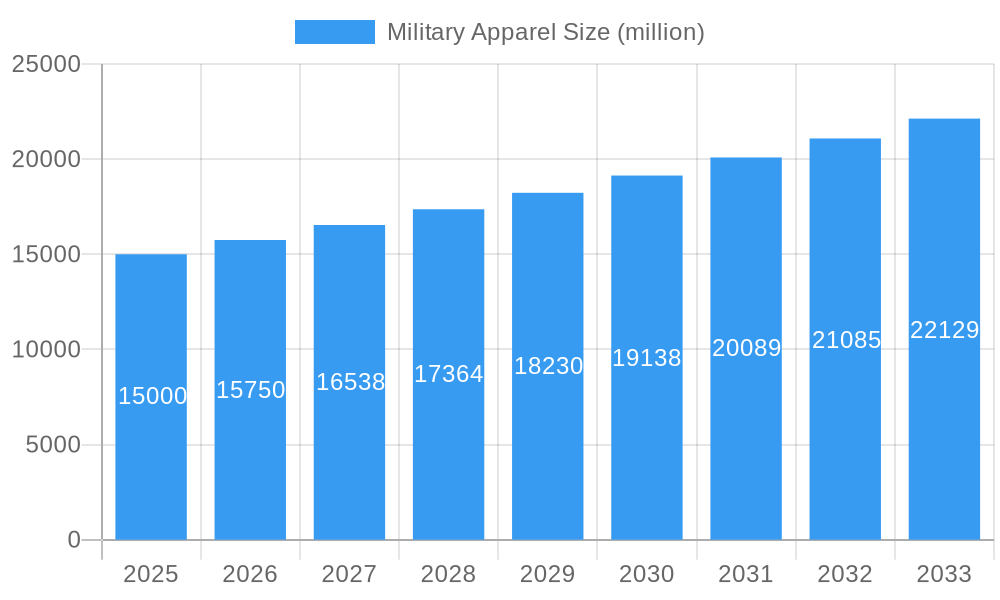
The global military apparel market is a dynamic sector characterized by consistent growth driven by increasing defense budgets worldwide, modernization of armed forces, and advancements in fabric technology. The market's expansion is fueled by the demand for high-performance, durable, and protective apparel designed for diverse operational environments. Technological advancements, such as the integration of advanced materials like high-performance fabrics offering superior protection against ballistic threats, extreme weather conditions, and improved camouflage capabilities, are key drivers. Furthermore, the rising adoption of body armor and specialized clothing for specific military operations, alongside an increased focus on soldier comfort and ergonomics, is significantly impacting market growth. We estimate the market size to be approximately $15 billion in 2025, based on industry reports and publicly available data from leading apparel companies. This figure projects a Compound Annual Growth Rate (CAGR) of approximately 5% between 2025 and 2033, driven by factors like evolving geopolitical scenarios and the ongoing need for advanced military equipment.
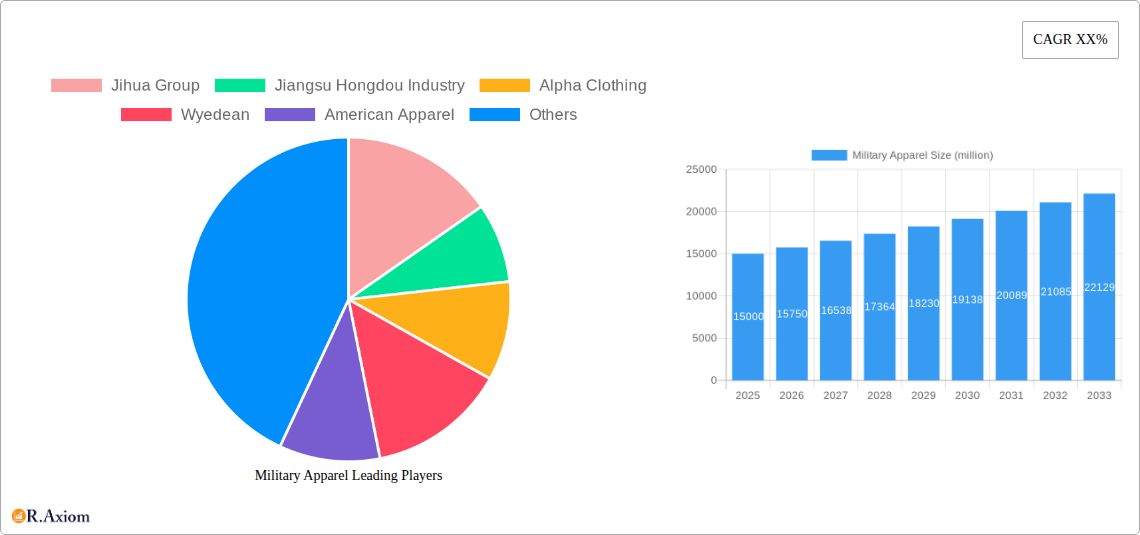
Military Apparel Market Size (In Billion)

Key players like Jihua Group, Jiangsu Hongdou Industry, and Crye Precision are shaping the market landscape through innovation and technological advancements. However, challenges remain, including fluctuations in global defense spending, stringent regulatory requirements, and the need for continuous innovation to meet ever-evolving military needs. Segmentation within the market is significant, encompassing various apparel types like combat uniforms, tactical vests, protective gear, and specialized clothing for specific operations. Regional differences in defense spending and technological adoption will influence market growth, with North America and Europe expected to maintain significant market share due to robust defense budgets and technological advancements. Competitive pressures are high, demanding continuous innovation in materials, design, and manufacturing processes. The forecast period (2025-2033) anticipates consistent growth, driven by ongoing modernization initiatives and technological advancements.
Military Apparel Company Market Share
Military Apparel Market Report: 2019-2033
This comprehensive report provides an in-depth analysis of the global military apparel market, offering invaluable insights for industry stakeholders, investors, and strategic decision-makers. The study period covers 2019-2033, with 2025 serving as both the base and estimated year. The forecast period spans 2025-2033, and the historical period encompasses 2019-2024. The report projects a market size exceeding $xx million by 2033, driven by factors detailed within.
Military Apparel Market Concentration & Innovation
This section analyzes the market concentration, innovation drivers, regulatory landscape, product substitutes, end-user trends, and mergers and acquisitions (M&A) activities within the military apparel industry. The market exhibits moderate concentration, with the top five players holding an estimated xx% market share in 2025. Innovation is driven primarily by advancements in materials science, focusing on enhanced durability, comfort, and protection. Stringent regulatory frameworks, particularly concerning safety and performance standards, significantly influence market dynamics. Key substitutes include civilian high-performance apparel, but specialized military applications often necessitate unique features. End-user trends favor lightweight, breathable, and modular designs, influencing product development strategies. M&A activity has seen significant transactions in recent years, with a combined deal value exceeding $xx million in the past five years. Specific examples include:
- The acquisition of X company by Y company in 2022 for $xx million.
- Strategic partnerships focusing on technological integration between Z and W companies.
Military Apparel Industry Trends & Insights
The global military apparel market is experiencing robust growth, projected to achieve a CAGR of xx% during the forecast period (2025-2033). This growth is propelled by increasing military spending globally, particularly in regions experiencing geopolitical instability. Technological advancements, including the integration of advanced materials like graphene and carbon nanotubes, enhance product performance, driving market penetration. Consumer preferences lean towards superior comfort, enhanced protection, and lighter-weight designs. Intense competition among leading players fuels innovation and price optimization, shaping the market landscape. The market penetration of advanced materials is steadily increasing, currently estimated at xx% and expected to rise significantly in the coming years. Market growth is particularly strong in developing economies due to increased military modernization programs.
Dominant Markets & Segments in Military Apparel
The North American market currently holds a dominant position, accounting for approximately xx% of the global market share in 2025. This dominance is attributable to:
- High military spending.
- Robust technological advancements.
- Strong domestic manufacturing capabilities.
Other key regions include Europe and Asia-Pacific, showing promising growth potential. Specific country-level analysis identifies the United States as the largest single market, driven by robust defense budgets and a strong emphasis on technological superiority. The tactical apparel segment currently dominates, exhibiting the highest market share and growth rate.
The dominance of North America is projected to continue throughout the forecast period, although the Asia-Pacific region is expected to show significant growth, fueled by increased military modernization in several nations.
Military Apparel Product Developments
Recent product innovations focus on enhancing functionality, comfort, and durability. Lightweight, high-performance materials are being incorporated to improve maneuverability, while advancements in camouflage technology increase tactical effectiveness. Modular designs allow for customization, meeting the specific needs of different military branches and operational environments. This emphasis on customization and technological integration provides significant competitive advantages to manufacturers, leading to increased market share.
Report Scope & Segmentation Analysis
The report segments the military apparel market by product type (e.g., combat uniforms, tactical vests, protective gear), material type (e.g., cotton, nylon, advanced composites), end-user (e.g., army, navy, air force), and geography. Each segment exhibits unique growth trajectories and competitive dynamics. For instance, the advanced materials segment is expected to experience the highest growth rate due to increasing demand for enhanced protection and performance. The combat uniform segment constitutes a significant portion of the market, showing steady growth driven by routine replacement cycles within military units.
Key Drivers of Military Apparel Growth
Several factors fuel the growth of the military apparel market:
- Increased global military spending.
- Technological advancements in materials science and manufacturing.
- Stringent safety and performance standards driving demand for advanced apparel.
- The growing need for lightweight and comfortable apparel for extended deployments.
Challenges in the Military Apparel Sector
The sector faces challenges, including:
- Fluctuations in global military spending.
- Supply chain disruptions impacting raw material availability.
- Intense competition among established players and emerging entrants.
- Stringent regulatory compliance requirements impacting manufacturing costs.
These factors could impede market growth if not adequately addressed. Fluctuations in raw material prices pose a significant risk to profitability, while intense competition necessitates continuous innovation to maintain a competitive edge.
Emerging Opportunities in Military Apparel
Opportunities abound in the military apparel sector, including:
- The development of smart fabrics with integrated sensors and communication capabilities.
- Expansion into emerging markets with increasing military modernization programs.
- Personalized apparel solutions tailored to individual soldier needs.
- Adoption of sustainable and eco-friendly materials to enhance environmental responsibility.
These opportunities are poised to drive significant market growth in the coming years.
Leading Players in the Military Apparel Market
- Jihua Group
- Jiangsu Hongdou Industry
- Alpha Clothing
- Wyedean
- American Apparel
- Crye Precision
- IBENA Textilwerke
- Royal TenCate
- Cortman Textiles
- Drifire
- Invista
- Manifattura Landi
- Milliken
- Realm & Empire
- Jinangsu Sunshine
Key Developments in Military Apparel Industry
- 2022 Q4: Crye Precision launched a new line of advanced combat uniforms featuring innovative materials.
- 2023 Q1: Invista announced a significant investment in research and development for next-generation military apparel fabrics.
- 2023 Q3: A strategic partnership between Jihua Group and Royal TenCate resulted in the development of a new camouflage pattern. (Specific examples of other partnerships and product launches can be added here based on actual data).
Strategic Outlook for Military Apparel Market
The military apparel market is poised for continued expansion, fueled by technological advancements, increased global military spending, and a growing demand for enhanced protection and comfort. Opportunities exist in developing innovative materials, integrating smart technologies, and expanding into new markets. Companies that successfully adapt to evolving technological trends and consumer preferences will be best positioned to capture significant market share in the years to come.
Military Apparel Segmentation
-
1. Application
- 1.1. Military
- 1.2. Civil
-
2. Types
- 2.1. Outerwear
- 2.2. Underwear
- 2.3. Other
Military Apparel Segmentation By Geography
-
1. North America
- 1.1. United States
- 1.2. Canada
- 1.3. Mexico
-
2. South America
- 2.1. Brazil
- 2.2. Argentina
- 2.3. Rest of South America
-
3. Europe
- 3.1. United Kingdom
- 3.2. Germany
- 3.3. France
- 3.4. Italy
- 3.5. Spain
- 3.6. Russia
- 3.7. Benelux
- 3.8. Nordics
- 3.9. Rest of Europe
-
4. Middle East & Africa
- 4.1. Turkey
- 4.2. Israel
- 4.3. GCC
- 4.4. North Africa
- 4.5. South Africa
- 4.6. Rest of Middle East & Africa
-
5. Asia Pacific
- 5.1. China
- 5.2. India
- 5.3. Japan
- 5.4. South Korea
- 5.5. ASEAN
- 5.6. Oceania
- 5.7. Rest of Asia Pacific
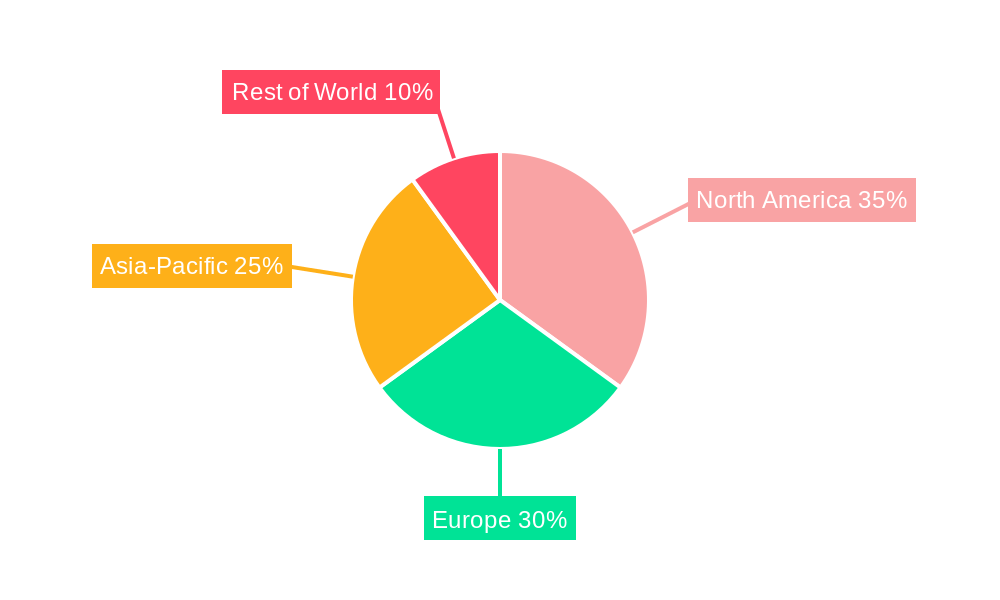
Military Apparel Regional Market Share
Geographic Coverage of Military Apparel
Military Apparel REPORT HIGHLIGHTS
| Aspects | Details |
|---|---|
| Study Period | 2020-2034 |
| Base Year | 2025 |
| Estimated Year | 2026 |
| Forecast Period | 2026-2034 |
| Historical Period | 2020-2025 |
| Growth Rate | CAGR of XX% from 2020-2034 |
| Segmentation |
|
Table of Contents
- 1. Introduction
- 1.1. Research Scope
- 1.2. Market Segmentation
- 1.3. Research Methodology
- 1.4. Definitions and Assumptions
- 2. Executive Summary
- 2.1. Introduction
- 3. Market Dynamics
- 3.1. Introduction
- 3.2. Market Drivers
- 3.3. Market Restrains
- 3.4. Market Trends
- 4. Market Factor Analysis
- 4.1. Porters Five Forces
- 4.2. Supply/Value Chain
- 4.3. PESTEL analysis
- 4.4. Market Entropy
- 4.5. Patent/Trademark Analysis
- 5. Global Military Apparel Analysis, Insights and Forecast, 2020-2032
- 5.1. Market Analysis, Insights and Forecast - by Application
- 5.1.1. Military
- 5.1.2. Civil
- 5.2. Market Analysis, Insights and Forecast - by Types
- 5.2.1. Outerwear
- 5.2.2. Underwear
- 5.2.3. Other
- 5.3. Market Analysis, Insights and Forecast - by Region
- 5.3.1. North America
- 5.3.2. South America
- 5.3.3. Europe
- 5.3.4. Middle East & Africa
- 5.3.5. Asia Pacific
- 5.1. Market Analysis, Insights and Forecast - by Application
- 6. North America Military Apparel Analysis, Insights and Forecast, 2020-2032
- 6.1. Market Analysis, Insights and Forecast - by Application
- 6.1.1. Military
- 6.1.2. Civil
- 6.2. Market Analysis, Insights and Forecast - by Types
- 6.2.1. Outerwear
- 6.2.2. Underwear
- 6.2.3. Other
- 6.1. Market Analysis, Insights and Forecast - by Application
- 7. South America Military Apparel Analysis, Insights and Forecast, 2020-2032
- 7.1. Market Analysis, Insights and Forecast - by Application
- 7.1.1. Military
- 7.1.2. Civil
- 7.2. Market Analysis, Insights and Forecast - by Types
- 7.2.1. Outerwear
- 7.2.2. Underwear
- 7.2.3. Other
- 7.1. Market Analysis, Insights and Forecast - by Application
- 8. Europe Military Apparel Analysis, Insights and Forecast, 2020-2032
- 8.1. Market Analysis, Insights and Forecast - by Application
- 8.1.1. Military
- 8.1.2. Civil
- 8.2. Market Analysis, Insights and Forecast - by Types
- 8.2.1. Outerwear
- 8.2.2. Underwear
- 8.2.3. Other
- 8.1. Market Analysis, Insights and Forecast - by Application
- 9. Middle East & Africa Military Apparel Analysis, Insights and Forecast, 2020-2032
- 9.1. Market Analysis, Insights and Forecast - by Application
- 9.1.1. Military
- 9.1.2. Civil
- 9.2. Market Analysis, Insights and Forecast - by Types
- 9.2.1. Outerwear
- 9.2.2. Underwear
- 9.2.3. Other
- 9.1. Market Analysis, Insights and Forecast - by Application
- 10. Asia Pacific Military Apparel Analysis, Insights and Forecast, 2020-2032
- 10.1. Market Analysis, Insights and Forecast - by Application
- 10.1.1. Military
- 10.1.2. Civil
- 10.2. Market Analysis, Insights and Forecast - by Types
- 10.2.1. Outerwear
- 10.2.2. Underwear
- 10.2.3. Other
- 10.1. Market Analysis, Insights and Forecast - by Application
- 11. Competitive Analysis
- 11.1. Global Market Share Analysis 2025
- 11.2. Company Profiles
- 11.2.1 Jihua Group
- 11.2.1.1. Overview
- 11.2.1.2. Products
- 11.2.1.3. SWOT Analysis
- 11.2.1.4. Recent Developments
- 11.2.1.5. Financials (Based on Availability)
- 11.2.2 Jiangsu Hongdou Industry
- 11.2.2.1. Overview
- 11.2.2.2. Products
- 11.2.2.3. SWOT Analysis
- 11.2.2.4. Recent Developments
- 11.2.2.5. Financials (Based on Availability)
- 11.2.3 Alpha Clothing
- 11.2.3.1. Overview
- 11.2.3.2. Products
- 11.2.3.3. SWOT Analysis
- 11.2.3.4. Recent Developments
- 11.2.3.5. Financials (Based on Availability)
- 11.2.4 Wyedean
- 11.2.4.1. Overview
- 11.2.4.2. Products
- 11.2.4.3. SWOT Analysis
- 11.2.4.4. Recent Developments
- 11.2.4.5. Financials (Based on Availability)
- 11.2.5 American Apparel
- 11.2.5.1. Overview
- 11.2.5.2. Products
- 11.2.5.3. SWOT Analysis
- 11.2.5.4. Recent Developments
- 11.2.5.5. Financials (Based on Availability)
- 11.2.6 Crye Precision
- 11.2.6.1. Overview
- 11.2.6.2. Products
- 11.2.6.3. SWOT Analysis
- 11.2.6.4. Recent Developments
- 11.2.6.5. Financials (Based on Availability)
- 11.2.7 IBENA Textilwerke
- 11.2.7.1. Overview
- 11.2.7.2. Products
- 11.2.7.3. SWOT Analysis
- 11.2.7.4. Recent Developments
- 11.2.7.5. Financials (Based on Availability)
- 11.2.8 Royal TenCate
- 11.2.8.1. Overview
- 11.2.8.2. Products
- 11.2.8.3. SWOT Analysis
- 11.2.8.4. Recent Developments
- 11.2.8.5. Financials (Based on Availability)
- 11.2.9 Cortman Textiles
- 11.2.9.1. Overview
- 11.2.9.2. Products
- 11.2.9.3. SWOT Analysis
- 11.2.9.4. Recent Developments
- 11.2.9.5. Financials (Based on Availability)
- 11.2.10 Drifire
- 11.2.10.1. Overview
- 11.2.10.2. Products
- 11.2.10.3. SWOT Analysis
- 11.2.10.4. Recent Developments
- 11.2.10.5. Financials (Based on Availability)
- 11.2.11 Invista
- 11.2.11.1. Overview
- 11.2.11.2. Products
- 11.2.11.3. SWOT Analysis
- 11.2.11.4. Recent Developments
- 11.2.11.5. Financials (Based on Availability)
- 11.2.12 Manifattura Landi
- 11.2.12.1. Overview
- 11.2.12.2. Products
- 11.2.12.3. SWOT Analysis
- 11.2.12.4. Recent Developments
- 11.2.12.5. Financials (Based on Availability)
- 11.2.13 Milliken
- 11.2.13.1. Overview
- 11.2.13.2. Products
- 11.2.13.3. SWOT Analysis
- 11.2.13.4. Recent Developments
- 11.2.13.5. Financials (Based on Availability)
- 11.2.14 Realm & Empire
- 11.2.14.1. Overview
- 11.2.14.2. Products
- 11.2.14.3. SWOT Analysis
- 11.2.14.4. Recent Developments
- 11.2.14.5. Financials (Based on Availability)
- 11.2.15 Jinangsu Sunshine
- 11.2.15.1. Overview
- 11.2.15.2. Products
- 11.2.15.3. SWOT Analysis
- 11.2.15.4. Recent Developments
- 11.2.15.5. Financials (Based on Availability)
- 11.2.1 Jihua Group
List of Figures
- Figure 1: Global Military Apparel Revenue Breakdown (million, %) by Region 2025 & 2033
- Figure 2: North America Military Apparel Revenue (million), by Application 2025 & 2033
- Figure 3: North America Military Apparel Revenue Share (%), by Application 2025 & 2033
- Figure 4: North America Military Apparel Revenue (million), by Types 2025 & 2033
- Figure 5: North America Military Apparel Revenue Share (%), by Types 2025 & 2033
- Figure 6: North America Military Apparel Revenue (million), by Country 2025 & 2033
- Figure 7: North America Military Apparel Revenue Share (%), by Country 2025 & 2033
- Figure 8: South America Military Apparel Revenue (million), by Application 2025 & 2033
- Figure 9: South America Military Apparel Revenue Share (%), by Application 2025 & 2033
- Figure 10: South America Military Apparel Revenue (million), by Types 2025 & 2033
- Figure 11: South America Military Apparel Revenue Share (%), by Types 2025 & 2033
- Figure 12: South America Military Apparel Revenue (million), by Country 2025 & 2033
- Figure 13: South America Military Apparel Revenue Share (%), by Country 2025 & 2033
- Figure 14: Europe Military Apparel Revenue (million), by Application 2025 & 2033
- Figure 15: Europe Military Apparel Revenue Share (%), by Application 2025 & 2033
- Figure 16: Europe Military Apparel Revenue (million), by Types 2025 & 2033
- Figure 17: Europe Military Apparel Revenue Share (%), by Types 2025 & 2033
- Figure 18: Europe Military Apparel Revenue (million), by Country 2025 & 2033
- Figure 19: Europe Military Apparel Revenue Share (%), by Country 2025 & 2033
- Figure 20: Middle East & Africa Military Apparel Revenue (million), by Application 2025 & 2033
- Figure 21: Middle East & Africa Military Apparel Revenue Share (%), by Application 2025 & 2033
- Figure 22: Middle East & Africa Military Apparel Revenue (million), by Types 2025 & 2033
- Figure 23: Middle East & Africa Military Apparel Revenue Share (%), by Types 2025 & 2033
- Figure 24: Middle East & Africa Military Apparel Revenue (million), by Country 2025 & 2033
- Figure 25: Middle East & Africa Military Apparel Revenue Share (%), by Country 2025 & 2033
- Figure 26: Asia Pacific Military Apparel Revenue (million), by Application 2025 & 2033
- Figure 27: Asia Pacific Military Apparel Revenue Share (%), by Application 2025 & 2033
- Figure 28: Asia Pacific Military Apparel Revenue (million), by Types 2025 & 2033
- Figure 29: Asia Pacific Military Apparel Revenue Share (%), by Types 2025 & 2033
- Figure 30: Asia Pacific Military Apparel Revenue (million), by Country 2025 & 2033
- Figure 31: Asia Pacific Military Apparel Revenue Share (%), by Country 2025 & 2033
List of Tables
- Table 1: Global Military Apparel Revenue million Forecast, by Application 2020 & 2033
- Table 2: Global Military Apparel Revenue million Forecast, by Types 2020 & 2033
- Table 3: Global Military Apparel Revenue million Forecast, by Region 2020 & 2033
- Table 4: Global Military Apparel Revenue million Forecast, by Application 2020 & 2033
- Table 5: Global Military Apparel Revenue million Forecast, by Types 2020 & 2033
- Table 6: Global Military Apparel Revenue million Forecast, by Country 2020 & 2033
- Table 7: United States Military Apparel Revenue (million) Forecast, by Application 2020 & 2033
- Table 8: Canada Military Apparel Revenue (million) Forecast, by Application 2020 & 2033
- Table 9: Mexico Military Apparel Revenue (million) Forecast, by Application 2020 & 2033
- Table 10: Global Military Apparel Revenue million Forecast, by Application 2020 & 2033
- Table 11: Global Military Apparel Revenue million Forecast, by Types 2020 & 2033
- Table 12: Global Military Apparel Revenue million Forecast, by Country 2020 & 2033
- Table 13: Brazil Military Apparel Revenue (million) Forecast, by Application 2020 & 2033
- Table 14: Argentina Military Apparel Revenue (million) Forecast, by Application 2020 & 2033
- Table 15: Rest of South America Military Apparel Revenue (million) Forecast, by Application 2020 & 2033
- Table 16: Global Military Apparel Revenue million Forecast, by Application 2020 & 2033
- Table 17: Global Military Apparel Revenue million Forecast, by Types 2020 & 2033
- Table 18: Global Military Apparel Revenue million Forecast, by Country 2020 & 2033
- Table 19: United Kingdom Military Apparel Revenue (million) Forecast, by Application 2020 & 2033
- Table 20: Germany Military Apparel Revenue (million) Forecast, by Application 2020 & 2033
- Table 21: France Military Apparel Revenue (million) Forecast, by Application 2020 & 2033
- Table 22: Italy Military Apparel Revenue (million) Forecast, by Application 2020 & 2033
- Table 23: Spain Military Apparel Revenue (million) Forecast, by Application 2020 & 2033
- Table 24: Russia Military Apparel Revenue (million) Forecast, by Application 2020 & 2033
- Table 25: Benelux Military Apparel Revenue (million) Forecast, by Application 2020 & 2033
- Table 26: Nordics Military Apparel Revenue (million) Forecast, by Application 2020 & 2033
- Table 27: Rest of Europe Military Apparel Revenue (million) Forecast, by Application 2020 & 2033
- Table 28: Global Military Apparel Revenue million Forecast, by Application 2020 & 2033
- Table 29: Global Military Apparel Revenue million Forecast, by Types 2020 & 2033
- Table 30: Global Military Apparel Revenue million Forecast, by Country 2020 & 2033
- Table 31: Turkey Military Apparel Revenue (million) Forecast, by Application 2020 & 2033
- Table 32: Israel Military Apparel Revenue (million) Forecast, by Application 2020 & 2033
- Table 33: GCC Military Apparel Revenue (million) Forecast, by Application 2020 & 2033
- Table 34: North Africa Military Apparel Revenue (million) Forecast, by Application 2020 & 2033
- Table 35: South Africa Military Apparel Revenue (million) Forecast, by Application 2020 & 2033
- Table 36: Rest of Middle East & Africa Military Apparel Revenue (million) Forecast, by Application 2020 & 2033
- Table 37: Global Military Apparel Revenue million Forecast, by Application 2020 & 2033
- Table 38: Global Military Apparel Revenue million Forecast, by Types 2020 & 2033
- Table 39: Global Military Apparel Revenue million Forecast, by Country 2020 & 2033
- Table 40: China Military Apparel Revenue (million) Forecast, by Application 2020 & 2033
- Table 41: India Military Apparel Revenue (million) Forecast, by Application 2020 & 2033
- Table 42: Japan Military Apparel Revenue (million) Forecast, by Application 2020 & 2033
- Table 43: South Korea Military Apparel Revenue (million) Forecast, by Application 2020 & 2033
- Table 44: ASEAN Military Apparel Revenue (million) Forecast, by Application 2020 & 2033
- Table 45: Oceania Military Apparel Revenue (million) Forecast, by Application 2020 & 2033
- Table 46: Rest of Asia Pacific Military Apparel Revenue (million) Forecast, by Application 2020 & 2033
Frequently Asked Questions
1. What is the projected Compound Annual Growth Rate (CAGR) of the Military Apparel?
The projected CAGR is approximately XX%.
2. Which companies are prominent players in the Military Apparel?
Key companies in the market include Jihua Group, Jiangsu Hongdou Industry, Alpha Clothing, Wyedean, American Apparel, Crye Precision, IBENA Textilwerke, Royal TenCate, Cortman Textiles, Drifire, Invista, Manifattura Landi, Milliken, Realm & Empire, Jinangsu Sunshine.
3. What are the main segments of the Military Apparel?
The market segments include Application, Types.
4. Can you provide details about the market size?
The market size is estimated to be USD XXX million as of 2022.
5. What are some drivers contributing to market growth?
N/A
6. What are the notable trends driving market growth?
N/A
7. Are there any restraints impacting market growth?
N/A
8. Can you provide examples of recent developments in the market?
N/A
9. What pricing options are available for accessing the report?
Pricing options include single-user, multi-user, and enterprise licenses priced at USD 4900.00, USD 7350.00, and USD 9800.00 respectively.
10. Is the market size provided in terms of value or volume?
The market size is provided in terms of value, measured in million.
11. Are there any specific market keywords associated with the report?
Yes, the market keyword associated with the report is "Military Apparel," which aids in identifying and referencing the specific market segment covered.
12. How do I determine which pricing option suits my needs best?
The pricing options vary based on user requirements and access needs. Individual users may opt for single-user licenses, while businesses requiring broader access may choose multi-user or enterprise licenses for cost-effective access to the report.
13. Are there any additional resources or data provided in the Military Apparel report?
While the report offers comprehensive insights, it's advisable to review the specific contents or supplementary materials provided to ascertain if additional resources or data are available.
14. How can I stay updated on further developments or reports in the Military Apparel?
To stay informed about further developments, trends, and reports in the Military Apparel, consider subscribing to industry newsletters, following relevant companies and organizations, or regularly checking reputable industry news sources and publications.
Methodology
Step 1 - Identification of Relevant Samples Size from Population Database



Step 2 - Approaches for Defining Global Market Size (Value, Volume* & Price*)

Note*: In applicable scenarios
Step 3 - Data Sources
Primary Research
- Web Analytics
- Survey Reports
- Research Institute
- Latest Research Reports
- Opinion Leaders
Secondary Research
- Annual Reports
- White Paper
- Latest Press Release
- Industry Association
- Paid Database
- Investor Presentations

Step 4 - Data Triangulation
Involves using different sources of information in order to increase the validity of a study
These sources are likely to be stakeholders in a program - participants, other researchers, program staff, other community members, and so on.
Then we put all data in single framework & apply various statistical tools to find out the dynamic on the market.
During the analysis stage, feedback from the stakeholder groups would be compared to determine areas of agreement as well as areas of divergence