


Key Insights
The Latin America Surgical Instruments Market is poised for substantial growth, projected to reach approximately USD 1193.7 million in 2024 and expand at a robust Compound Annual Growth Rate (CAGR) of 10.6% through 2033. This upward trajectory is underpinned by several key drivers, including the increasing prevalence of chronic diseases, a growing demand for minimally invasive surgical procedures, and advancements in surgical technology. The rising healthcare expenditure across Latin American nations, coupled with greater patient awareness and accessibility to advanced medical treatments, further fuels this market expansion. Key segments driving this growth include handheld and laparoscopic devices, essential for a wide range of procedures, and electro-surgical devices, which offer enhanced precision and patient outcomes. The applications in gynecology and urology, cardiology, and orthopedics are particularly significant, reflecting the broad utility of these instruments in addressing prevalent health concerns within the region.
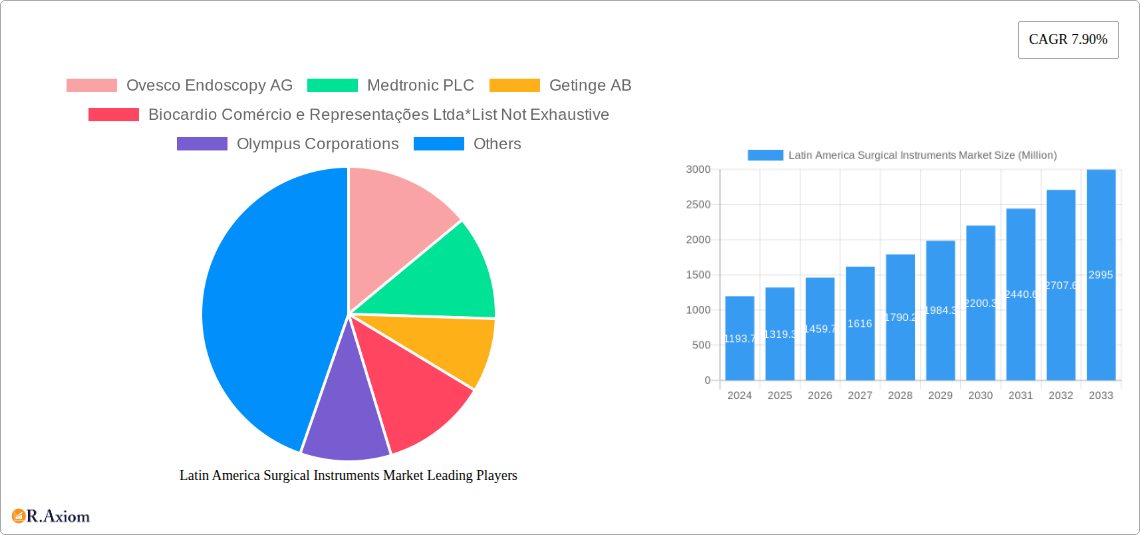
Latin America Surgical Instruments Market Market Size (In Billion)

The market's expansion is further supported by emerging trends such as the integration of AI and robotics in surgical instruments, leading to more sophisticated and efficient procedures. Investments in healthcare infrastructure and a growing number of trained surgical professionals are also contributing factors. While the market is dynamic, certain restraints, such as the high cost of advanced surgical equipment and potential reimbursement challenges in some countries, need to be addressed. However, the overall outlook remains highly positive, with significant opportunities in countries like Brazil and Mexico, which are leading the adoption of advanced surgical technologies. The competitive landscape features major global players alongside emerging regional companies, fostering innovation and a diverse product offering that caters to the evolving needs of the Latin American healthcare sector.

Latin America Surgical Instruments Market Company Market Share
This comprehensive report provides an in-depth analysis of the Latin America surgical instruments market, a dynamic sector poised for significant growth. Covering the period from 2019 to 2033, with a base year of 2025 and a forecast period of 2025–2033, this report offers actionable insights for industry stakeholders. We delve into market concentration, innovation trends, dominant market segments, and key growth drivers, providing a detailed outlook for this crucial region. The market is expected to reach a valuation of over xx million USD by 2033.
Latin America Surgical Instruments Market Market Concentration & Innovation
The Latin America surgical instruments market exhibits a moderate level of concentration, with several large multinational corporations and a growing number of regional players vying for market share. Innovation is a key driver, fueled by advancements in minimally invasive techniques, robotics, and material science. Regulatory frameworks, overseen by bodies like Brazil's Anvisa and Argentina's ANMAT, play a crucial role in product approvals and market access. The surgical instruments market is characterized by a continuous drive for improved efficacy, reduced patient trauma, and enhanced surgical outcomes. While direct product substitutes are limited within the surgical instrument category, advancements in alternative treatment modalities, such as drug-eluting devices or non-invasive procedures, could present indirect competition. End-user trends are leaning towards safer, more efficient, and cost-effective surgical solutions, driving demand for sophisticated instrumentation. Mergers and acquisitions (M&A) activities are observed as companies seek to expand their product portfolios, geographic reach, and technological capabilities. The surgical instruments market size in Latin America is projected to grow substantially due to these factors. Recent M&A deals, valued at over xx million USD, highlight the consolidation and strategic realignments within the sector.
Latin America Surgical Instruments Market Industry Trends & Insights
The Latin America surgical instruments market is on an upward trajectory, driven by an increasing prevalence of chronic diseases, a growing aging population, and rising healthcare expenditure across the region. The surgical devices market is experiencing a significant CAGR of approximately xx% during the forecast period. Technological disruptions, including the adoption of advanced robotics in surgery and the integration of artificial intelligence for surgical planning, are transforming the landscape. These innovations are leading to more precise and less invasive procedures, ultimately improving patient outcomes. Consumer preferences are increasingly focused on minimally invasive surgery (MIS) due to shorter recovery times, reduced pain, and smaller scars. This trend directly fuels the demand for specialized laparoscopic surgical instruments and other instruments designed for MIS. The competitive dynamics are intensifying, with both established global players and emerging local manufacturers competing on price, product quality, and technological innovation. Market penetration is expected to deepen as healthcare infrastructure improves and more sophisticated medical technologies become accessible to a wider population. The surgical equipment market in Latin America is also influenced by government initiatives aimed at improving healthcare access and quality. Furthermore, the increasing awareness among the patient population regarding advanced surgical procedures is also a significant contributor to market growth. The global surgical instruments market trends are largely mirrored in Latin America, with a strong emphasis on digitalization and data integration within surgical workflows.
Dominant Markets & Segments in Latin America Surgical Instruments Market
Brazil and Mexico stand out as the dominant markets within the Latin America surgical instruments market, driven by their large populations, robust healthcare infrastructure, and significant investments in medical technology. Brazil, with its substantial government spending on healthcare and a growing private healthcare sector, represents the largest market share. Mexico follows closely, with its expanding medical tourism industry and increasing adoption of advanced surgical techniques.
Products:
- Handheld Devices: These remain a fundamental segment, with consistent demand across various surgical specialties due to their versatility and affordability.
- Laparoscopic Devices: Experiencing rapid growth, fueled by the rising popularity of minimally invasive surgery. The demand for advanced laparoscopic surgical instruments such as graspers, dissectors, and staplers is particularly high.
- Electro Surgical Devices: Crucial for hemostasis and tissue dissection, these devices are essential in numerous surgical procedures. Technological advancements in radiofrequency and ultrasonic technology are driving innovation in this segment.
- Wound Closure Devices: Including sutures, staples, and adhesives, this segment is experiencing steady growth due to the increasing number of surgical procedures.
- Trocars and Access Devices: Essential for laparoscopic and minimally invasive surgeries, this segment is directly linked to the growth of MIS.
- Other Products: Encompassing a wide range of specialized instruments catering to niche surgical applications.
Applications:
- Gynecology and Urology: These specialties are significant contributors, with a high volume of surgical procedures performed annually. The demand for specialized instruments in these fields is substantial.
- Cardiology: The increasing burden of cardiovascular diseases drives the demand for advanced cardiac surgical instruments and devices.
- Orthopaedic: Growing prevalence of musculoskeletal disorders and an aging population contribute to the robust growth of the orthopaedic surgical instruments segment.
- Neurology: Advances in neurosurgical techniques and instruments are crucial for treating complex neurological conditions.
- Other Applications: Including general surgery, ophthalmology, and otolaryngology, which collectively represent a significant portion of the market.
The Latin America surgical instruments market is being shaped by economic policies that favor healthcare investment, infrastructure development that enhances surgical access, and increasing adoption of international surgical standards. The surgical instruments market share is distributed among various players, with a clear trend towards market consolidation.
Latin America Surgical Instruments Market Product Developments
Product developments in the Latin America surgical instruments market are focused on enhancing precision, reducing invasiveness, and improving surgeon ergonomics. Innovations in materials science are leading to lighter, stronger, and more biocompatible instruments. The integration of smart technologies, such as sensors and connectivity, is enabling real-time feedback and data collection during surgery. These advancements provide competitive advantages by offering superior performance, improved patient safety, and streamlined surgical workflows. The market fit for these new products is strong, as healthcare providers increasingly seek solutions that optimize surgical outcomes and reduce healthcare costs. The demand for advanced surgical equipment continues to grow.
Report Scope & Segmentation Analysis
This report provides a comprehensive segmentation of the Latin America surgical instruments market. The market is analyzed across the following segments:
- Products: Handheld Devices, Laparoscopic Devices, Electro Surgical Devices, Wound Closure Devices, Trocars and Access Devices, and Other Products. Growth projections for each product category are detailed, considering market size and competitive dynamics.
- Applications: Gynecology and Urology, Cardiology, Orthopaedic, Neurology, and Other Applications. Each application segment's market size and growth potential are assessed, along with the specific instruments and technologies driving demand.
- Geography: Mexico, Brazil, Argentina, and Rest of Latin America. The analysis includes country-specific market sizes, growth rates, and the competitive landscape within each geographical region.
The report offers granular insights into the market dynamics of each segment, predicting future market sizes and competitive landscapes to guide strategic decision-making. The surgical instruments market forecast is meticulously detailed for each segment.
Key Drivers of Latin America Surgical Instruments Market Growth
Several key drivers are propelling the growth of the Latin America surgical instruments market. The increasing incidence of lifestyle-related diseases such as cardiovascular and metabolic disorders necessitates more surgical interventions. A growing and aging population also contributes to a higher demand for surgical procedures, particularly in orthopaedics and general surgery. Significant government and private sector investments in upgrading healthcare infrastructure and medical technology across Latin American countries are crucial. Furthermore, the expanding medical tourism sector in countries like Mexico and Brazil attracts international patients, thereby boosting the demand for high-quality surgical instruments. The rising adoption of minimally invasive surgical techniques, driven by patient preference for faster recovery and reduced scarring, is a major catalyst.
Challenges in the Latin America Surgical Instruments Market Sector
Despite the promising growth prospects, the Latin America surgical instruments market faces several challenges. Stringent and varying regulatory approval processes across different countries can lead to delayed market entry and increased compliance costs for manufacturers. Economic instability and currency fluctuations in some Latin American economies can impact healthcare spending and the purchasing power of hospitals. The high cost of advanced surgical technologies and instruments can be a barrier to adoption, especially in public healthcare systems with limited budgets. Supply chain disruptions, exacerbated by global events, can lead to shortages and increased prices of raw materials and finished products, impacting the surgical instruments market value. Intense competition from both global and local players also puts pressure on pricing and profit margins.
Emerging Opportunities in Latin America Surgical Instruments Market
The Latin America surgical instruments market presents numerous emerging opportunities for stakeholders. The untapped potential in rural and underserved areas offers significant scope for market expansion, provided affordable and adaptable surgical solutions can be developed. The increasing focus on specialized surgical procedures, such as bariatric surgery and advanced oncology interventions, creates demand for niche and highly specialized surgical instruments. The growing adoption of digital health technologies and robotics in surgery opens avenues for companies offering integrated surgical systems and smart instrumentation. Furthermore, collaborations between local manufacturers and international companies can foster knowledge transfer and accelerate the development of locally relevant and cost-effective surgical solutions, enhancing the surgical instruments market growth.
Leading Players in the Latin America Surgical Instruments Market Market
- Ovesco Endoscopy AG
- Medtronic PLC
- Getinge AB
- Biocardio Comércio e Representações Ltda
- Olympus Corporations
- Conmed Corporation
- Johnson & Johnson
- B Braun Melsungen AG
- Stryker Corporation
- Boston Scientific Corporation
- BMR Medical
Key Developments in Latin America Surgical Instruments Market Industry
- July 2022: Ovesco Endoscopy AG received market approval from the Brazilian Health Regulatory Agency (Anvisa) for the OTSC System and mini OTSC System. The OTSC System Set is an instrument used for flexible endoscopy, enhancing minimally invasive procedures.
- March 2022: MicroPort CardioFlow Medtech Corporation (CardioFlow Medtech) announced that their Alwide Plus Balloon Catheter (Alwide Plus) received marketing approval from the Argentine National Administration of Drugs, Foods, and Medical Devices (ANMAT), signifying advancements in cardiovascular interventions.
These developments highlight the strategic importance of the Latin American market for global manufacturers and signal a commitment to expanding product portfolios and market reach within the region.
Strategic Outlook for Latin America Surgical Instruments Market Market
The strategic outlook for the Latin America surgical instruments market is highly positive, driven by a confluence of factors including expanding healthcare access, technological advancements, and increasing patient demand for effective treatments. Growth catalysts include the ongoing shift towards minimally invasive surgery, the development of advanced robotic surgical systems, and the increasing integration of digital technologies in healthcare. Companies that focus on innovation, cost-effectiveness, and robust distribution networks will be well-positioned to capitalize on the significant opportunities within this burgeoning market. Strategic partnerships and localized manufacturing initiatives can further enhance market penetration and long-term sustainability, ensuring continued growth in the surgical instruments market.
Latin America Surgical Instruments Market Segmentation
-
1. Products
- 1.1. Handheld Devices
- 1.2. Laproscopic Devices
- 1.3. Electro Surgical Devices
- 1.4. Wound Closure Devices
- 1.5. Trocars and Access Devices
- 1.6. Other Products
-
2. Applications
- 2.1. Gynecology and Urology
- 2.2. Cardiology
- 2.3. Orthopaedic
- 2.4. Neurology
- 2.5. Other Applications
-
3. Geography
- 3.1. Mexico
- 3.2. Brazil
- 3.3. Argentina
- 3.4. Rest of Latin America
Latin America Surgical Instruments Market Segmentation By Geography
- 1. Mexico
- 2. Brazil
- 3. Argentina
- 4. Rest of Latin America
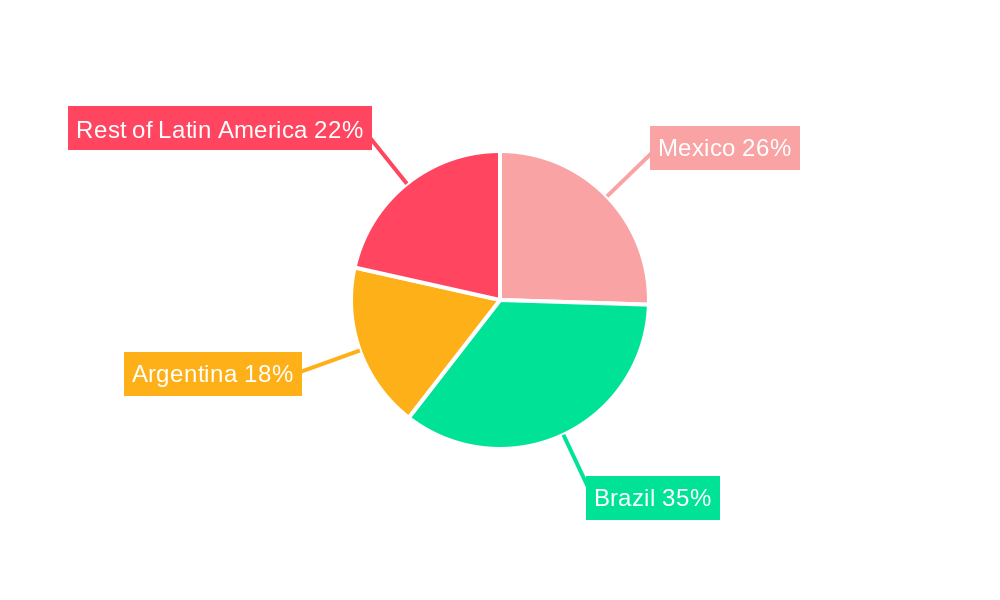
Latin America Surgical Instruments Market Regional Market Share
Geographic Coverage of Latin America Surgical Instruments Market
Latin America Surgical Instruments Market REPORT HIGHLIGHTS
| Aspects | Details |
|---|---|
| Study Period | 2020-2034 |
| Base Year | 2025 |
| Estimated Year | 2026 |
| Forecast Period | 2026-2034 |
| Historical Period | 2020-2025 |
| Growth Rate | CAGR of 10.6% from 2020-2034 |
| Segmentation |
|
Table of Contents
- 1. Introduction
- 1.1. Research Scope
- 1.2. Market Segmentation
- 1.3. Research Methodology
- 1.4. Definitions and Assumptions
- 2. Executive Summary
- 2.1. Introduction
- 3. Market Dynamics
- 3.1. Introduction
- 3.2. Market Drivers
- 3.2.1. Increasing Number of Surgeries; Growing Cases of Injuries and Accidents; Growing Demand for Minimally Invasive Devices
- 3.3. Market Restrains
- 3.3.1. Stringent Government Regulations; Improper Reimbursement for Surgical Devices
- 3.4. Market Trends
- 3.4.1. Handheld Surgical Devices are Expected to Witness a High Growth During the Forecast Period
- 4. Market Factor Analysis
- 4.1. Porters Five Forces
- 4.2. Supply/Value Chain
- 4.3. PESTEL analysis
- 4.4. Market Entropy
- 4.5. Patent/Trademark Analysis
- 5. Latin America Surgical Instruments Market Analysis, Insights and Forecast, 2020-2032
- 5.1. Market Analysis, Insights and Forecast - by Products
- 5.1.1. Handheld Devices
- 5.1.2. Laproscopic Devices
- 5.1.3. Electro Surgical Devices
- 5.1.4. Wound Closure Devices
- 5.1.5. Trocars and Access Devices
- 5.1.6. Other Products
- 5.2. Market Analysis, Insights and Forecast - by Applications
- 5.2.1. Gynecology and Urology
- 5.2.2. Cardiology
- 5.2.3. Orthopaedic
- 5.2.4. Neurology
- 5.2.5. Other Applications
- 5.3. Market Analysis, Insights and Forecast - by Geography
- 5.3.1. Mexico
- 5.3.2. Brazil
- 5.3.3. Argentina
- 5.3.4. Rest of Latin America
- 5.4. Market Analysis, Insights and Forecast - by Region
- 5.4.1. Mexico
- 5.4.2. Brazil
- 5.4.3. Argentina
- 5.4.4. Rest of Latin America
- 5.1. Market Analysis, Insights and Forecast - by Products
- 6. Mexico Latin America Surgical Instruments Market Analysis, Insights and Forecast, 2020-2032
- 6.1. Market Analysis, Insights and Forecast - by Products
- 6.1.1. Handheld Devices
- 6.1.2. Laproscopic Devices
- 6.1.3. Electro Surgical Devices
- 6.1.4. Wound Closure Devices
- 6.1.5. Trocars and Access Devices
- 6.1.6. Other Products
- 6.2. Market Analysis, Insights and Forecast - by Applications
- 6.2.1. Gynecology and Urology
- 6.2.2. Cardiology
- 6.2.3. Orthopaedic
- 6.2.4. Neurology
- 6.2.5. Other Applications
- 6.3. Market Analysis, Insights and Forecast - by Geography
- 6.3.1. Mexico
- 6.3.2. Brazil
- 6.3.3. Argentina
- 6.3.4. Rest of Latin America
- 6.1. Market Analysis, Insights and Forecast - by Products
- 7. Brazil Latin America Surgical Instruments Market Analysis, Insights and Forecast, 2020-2032
- 7.1. Market Analysis, Insights and Forecast - by Products
- 7.1.1. Handheld Devices
- 7.1.2. Laproscopic Devices
- 7.1.3. Electro Surgical Devices
- 7.1.4. Wound Closure Devices
- 7.1.5. Trocars and Access Devices
- 7.1.6. Other Products
- 7.2. Market Analysis, Insights and Forecast - by Applications
- 7.2.1. Gynecology and Urology
- 7.2.2. Cardiology
- 7.2.3. Orthopaedic
- 7.2.4. Neurology
- 7.2.5. Other Applications
- 7.3. Market Analysis, Insights and Forecast - by Geography
- 7.3.1. Mexico
- 7.3.2. Brazil
- 7.3.3. Argentina
- 7.3.4. Rest of Latin America
- 7.1. Market Analysis, Insights and Forecast - by Products
- 8. Argentina Latin America Surgical Instruments Market Analysis, Insights and Forecast, 2020-2032
- 8.1. Market Analysis, Insights and Forecast - by Products
- 8.1.1. Handheld Devices
- 8.1.2. Laproscopic Devices
- 8.1.3. Electro Surgical Devices
- 8.1.4. Wound Closure Devices
- 8.1.5. Trocars and Access Devices
- 8.1.6. Other Products
- 8.2. Market Analysis, Insights and Forecast - by Applications
- 8.2.1. Gynecology and Urology
- 8.2.2. Cardiology
- 8.2.3. Orthopaedic
- 8.2.4. Neurology
- 8.2.5. Other Applications
- 8.3. Market Analysis, Insights and Forecast - by Geography
- 8.3.1. Mexico
- 8.3.2. Brazil
- 8.3.3. Argentina
- 8.3.4. Rest of Latin America
- 8.1. Market Analysis, Insights and Forecast - by Products
- 9. Rest of Latin America Latin America Surgical Instruments Market Analysis, Insights and Forecast, 2020-2032
- 9.1. Market Analysis, Insights and Forecast - by Products
- 9.1.1. Handheld Devices
- 9.1.2. Laproscopic Devices
- 9.1.3. Electro Surgical Devices
- 9.1.4. Wound Closure Devices
- 9.1.5. Trocars and Access Devices
- 9.1.6. Other Products
- 9.2. Market Analysis, Insights and Forecast - by Applications
- 9.2.1. Gynecology and Urology
- 9.2.2. Cardiology
- 9.2.3. Orthopaedic
- 9.2.4. Neurology
- 9.2.5. Other Applications
- 9.3. Market Analysis, Insights and Forecast - by Geography
- 9.3.1. Mexico
- 9.3.2. Brazil
- 9.3.3. Argentina
- 9.3.4. Rest of Latin America
- 9.1. Market Analysis, Insights and Forecast - by Products
- 10. Competitive Analysis
- 10.1. Market Share Analysis 2025
- 10.2. Company Profiles
- 10.2.1 Ovesco Endoscopy AG
- 10.2.1.1. Overview
- 10.2.1.2. Products
- 10.2.1.3. SWOT Analysis
- 10.2.1.4. Recent Developments
- 10.2.1.5. Financials (Based on Availability)
- 10.2.2 Medtronic PLC
- 10.2.2.1. Overview
- 10.2.2.2. Products
- 10.2.2.3. SWOT Analysis
- 10.2.2.4. Recent Developments
- 10.2.2.5. Financials (Based on Availability)
- 10.2.3 Getinge AB
- 10.2.3.1. Overview
- 10.2.3.2. Products
- 10.2.3.3. SWOT Analysis
- 10.2.3.4. Recent Developments
- 10.2.3.5. Financials (Based on Availability)
- 10.2.4 Biocardio Comércio e Representações Ltda*List Not Exhaustive
- 10.2.4.1. Overview
- 10.2.4.2. Products
- 10.2.4.3. SWOT Analysis
- 10.2.4.4. Recent Developments
- 10.2.4.5. Financials (Based on Availability)
- 10.2.5 Olympus Corporations
- 10.2.5.1. Overview
- 10.2.5.2. Products
- 10.2.5.3. SWOT Analysis
- 10.2.5.4. Recent Developments
- 10.2.5.5. Financials (Based on Availability)
- 10.2.6 Conmed Corporation
- 10.2.6.1. Overview
- 10.2.6.2. Products
- 10.2.6.3. SWOT Analysis
- 10.2.6.4. Recent Developments
- 10.2.6.5. Financials (Based on Availability)
- 10.2.7 Johnson & Johnson
- 10.2.7.1. Overview
- 10.2.7.2. Products
- 10.2.7.3. SWOT Analysis
- 10.2.7.4. Recent Developments
- 10.2.7.5. Financials (Based on Availability)
- 10.2.8 B Braun Melsungen AG
- 10.2.8.1. Overview
- 10.2.8.2. Products
- 10.2.8.3. SWOT Analysis
- 10.2.8.4. Recent Developments
- 10.2.8.5. Financials (Based on Availability)
- 10.2.9 Stryker Corporation
- 10.2.9.1. Overview
- 10.2.9.2. Products
- 10.2.9.3. SWOT Analysis
- 10.2.9.4. Recent Developments
- 10.2.9.5. Financials (Based on Availability)
- 10.2.10 Boston Scientific Corporation
- 10.2.10.1. Overview
- 10.2.10.2. Products
- 10.2.10.3. SWOT Analysis
- 10.2.10.4. Recent Developments
- 10.2.10.5. Financials (Based on Availability)
- 10.2.11 BMR Medical
- 10.2.11.1. Overview
- 10.2.11.2. Products
- 10.2.11.3. SWOT Analysis
- 10.2.11.4. Recent Developments
- 10.2.11.5. Financials (Based on Availability)
- 10.2.1 Ovesco Endoscopy AG
List of Figures
- Figure 1: Latin America Surgical Instruments Market Revenue Breakdown (undefined, %) by Product 2025 & 2033
- Figure 2: Latin America Surgical Instruments Market Share (%) by Company 2025
List of Tables
- Table 1: Latin America Surgical Instruments Market Revenue undefined Forecast, by Products 2020 & 2033
- Table 2: Latin America Surgical Instruments Market Revenue undefined Forecast, by Applications 2020 & 2033
- Table 3: Latin America Surgical Instruments Market Revenue undefined Forecast, by Geography 2020 & 2033
- Table 4: Latin America Surgical Instruments Market Revenue undefined Forecast, by Region 2020 & 2033
- Table 5: Latin America Surgical Instruments Market Revenue undefined Forecast, by Products 2020 & 2033
- Table 6: Latin America Surgical Instruments Market Revenue undefined Forecast, by Applications 2020 & 2033
- Table 7: Latin America Surgical Instruments Market Revenue undefined Forecast, by Geography 2020 & 2033
- Table 8: Latin America Surgical Instruments Market Revenue undefined Forecast, by Country 2020 & 2033
- Table 9: Latin America Surgical Instruments Market Revenue undefined Forecast, by Products 2020 & 2033
- Table 10: Latin America Surgical Instruments Market Revenue undefined Forecast, by Applications 2020 & 2033
- Table 11: Latin America Surgical Instruments Market Revenue undefined Forecast, by Geography 2020 & 2033
- Table 12: Latin America Surgical Instruments Market Revenue undefined Forecast, by Country 2020 & 2033
- Table 13: Latin America Surgical Instruments Market Revenue undefined Forecast, by Products 2020 & 2033
- Table 14: Latin America Surgical Instruments Market Revenue undefined Forecast, by Applications 2020 & 2033
- Table 15: Latin America Surgical Instruments Market Revenue undefined Forecast, by Geography 2020 & 2033
- Table 16: Latin America Surgical Instruments Market Revenue undefined Forecast, by Country 2020 & 2033
- Table 17: Latin America Surgical Instruments Market Revenue undefined Forecast, by Products 2020 & 2033
- Table 18: Latin America Surgical Instruments Market Revenue undefined Forecast, by Applications 2020 & 2033
- Table 19: Latin America Surgical Instruments Market Revenue undefined Forecast, by Geography 2020 & 2033
- Table 20: Latin America Surgical Instruments Market Revenue undefined Forecast, by Country 2020 & 2033
Frequently Asked Questions
1. What is the projected Compound Annual Growth Rate (CAGR) of the Latin America Surgical Instruments Market?
The projected CAGR is approximately 10.6%.
2. Which companies are prominent players in the Latin America Surgical Instruments Market?
Key companies in the market include Ovesco Endoscopy AG, Medtronic PLC, Getinge AB, Biocardio Comércio e Representações Ltda*List Not Exhaustive, Olympus Corporations, Conmed Corporation, Johnson & Johnson, B Braun Melsungen AG, Stryker Corporation, Boston Scientific Corporation, BMR Medical.
3. What are the main segments of the Latin America Surgical Instruments Market?
The market segments include Products, Applications, Geography.
4. Can you provide details about the market size?
The market size is estimated to be USD XXX N/A as of 2022.
5. What are some drivers contributing to market growth?
Increasing Number of Surgeries; Growing Cases of Injuries and Accidents; Growing Demand for Minimally Invasive Devices.
6. What are the notable trends driving market growth?
Handheld Surgical Devices are Expected to Witness a High Growth During the Forecast Period.
7. Are there any restraints impacting market growth?
Stringent Government Regulations; Improper Reimbursement for Surgical Devices.
8. Can you provide examples of recent developments in the market?
July 2022: Ovesco received market approval from the Brazilian Health Regulatory Agency (Anvisa) for the OTSC System and mini OTSC System. OTSC System Set is an instrument used for flexible endoscopy.
9. What pricing options are available for accessing the report?
Pricing options include single-user, multi-user, and enterprise licenses priced at USD 4750, USD 5250, and USD 8750 respectively.
10. Is the market size provided in terms of value or volume?
The market size is provided in terms of value, measured in N/A.
11. Are there any specific market keywords associated with the report?
Yes, the market keyword associated with the report is "Latin America Surgical Instruments Market," which aids in identifying and referencing the specific market segment covered.
12. How do I determine which pricing option suits my needs best?
The pricing options vary based on user requirements and access needs. Individual users may opt for single-user licenses, while businesses requiring broader access may choose multi-user or enterprise licenses for cost-effective access to the report.
13. Are there any additional resources or data provided in the Latin America Surgical Instruments Market report?
While the report offers comprehensive insights, it's advisable to review the specific contents or supplementary materials provided to ascertain if additional resources or data are available.
14. How can I stay updated on further developments or reports in the Latin America Surgical Instruments Market?
To stay informed about further developments, trends, and reports in the Latin America Surgical Instruments Market, consider subscribing to industry newsletters, following relevant companies and organizations, or regularly checking reputable industry news sources and publications.
Methodology
Step 1 - Identification of Relevant Samples Size from Population Database



Step 2 - Approaches for Defining Global Market Size (Value, Volume* & Price*)

Note*: In applicable scenarios
Step 3 - Data Sources
Primary Research
- Web Analytics
- Survey Reports
- Research Institute
- Latest Research Reports
- Opinion Leaders
Secondary Research
- Annual Reports
- White Paper
- Latest Press Release
- Industry Association
- Paid Database
- Investor Presentations

Step 4 - Data Triangulation
Involves using different sources of information in order to increase the validity of a study
These sources are likely to be stakeholders in a program - participants, other researchers, program staff, other community members, and so on.
Then we put all data in single framework & apply various statistical tools to find out the dynamic on the market.
During the analysis stage, feedback from the stakeholder groups would be compared to determine areas of agreement as well as areas of divergence